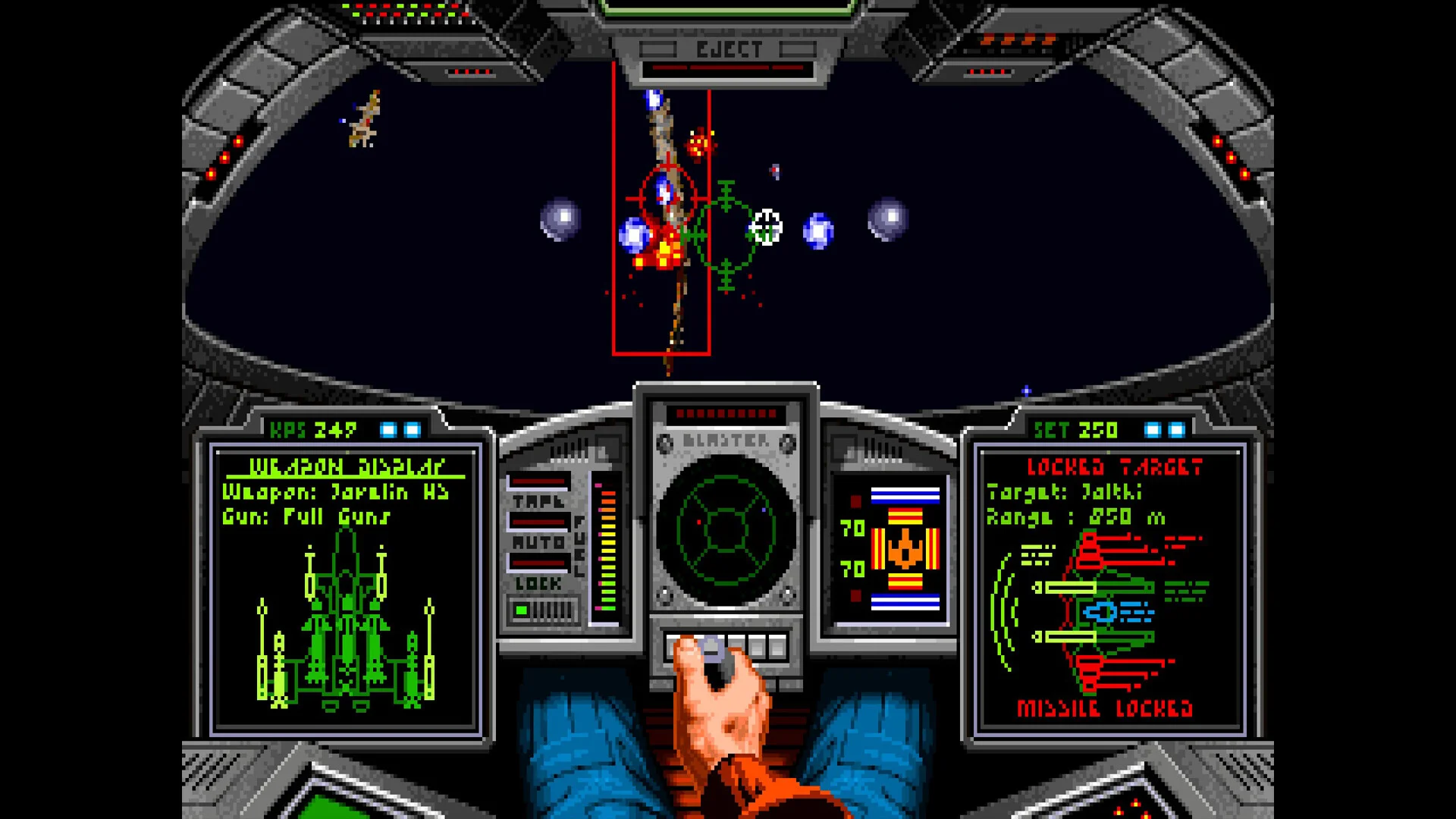
- Wing Commander 35th Anniversary Edition controls can vary by historical build and active input profile.
- Keyboard and joystick-style input remain the safest starting point for classic flight behavior.
- Target cycling and speed control are more important than constant maximum throttle.
- Controller support is available, but bindings should be tested before a serious campaign sortie.
- Separate saves help when comparing DOS, WCAT, Kilrathi Saga, and WCDX configurations.
Wing Commander 35th Anniversary Edition controls: Flight Basics
Wing Commander 35th Anniversary Edition controls are organized around six practical tasks: steering the fighter, managing speed, selecting targets, firing weapons, changing views, and handling menus. The anniversary package preserves multiple historical versions, so the exact key labels can differ between the DOS/WCAT and Kilrathi Saga/WCDX families.
Start by opening the active control profile and identifying the commands assigned to pitch, yaw, roll, throttle, afterburner, primary fire, secondary fire, target cycling, and pause. Do not assume that a remembered DOS command uses the same key in a modern controller profile.
| Control Group | Main Function | Setup Priority | Practical Use |
|---|---|---|---|
| Flight | Pitch, yaw, roll | High | Aim the fighter and maintain position during turns |
| Speed | Throttle and braking | High | Match formation speed or create distance |
| Combat | Guns and missiles | High | Attack targets with the correct weapon |
| Targeting | Cycle, select, lock | High | Keep the correct hostile contact selected |
| View | Cockpit and external views | Medium | Improve awareness during navigation |
| Interface | Pause, menu, exit | Medium | Manage sorties and configuration safely |
Keyboard
- Fast access to many commands
- Useful for historical layouts
- Easy to remap by function
Joystick
- Matches the classic flight style
- Natural control over direction
- Helpful for long sorties
Gamepad
- Practical for modern systems
- Requires careful trigger mapping
- Works well with Steam Input profiles
Mouse
- Useful for interface navigation
- Flight behavior depends on the profile
- Test sensitivity before combat
Map the commands you use during combat before assigning secondary interface actions. A reachable target-cycle or afterburner command is more valuable than a convenient menu shortcut.
Keyboard, Mouse, and Controller Mapping
The best control device depends on whether you want historical authenticity, modern convenience, or easy access to a handheld layout. The original game’s flight model is built around directional input and deliberate speed management, so a profile with precise movement is usually more useful than one with many unused shortcuts.
For keyboard play, group related commands together. Keep flight controls near the center of your movement cluster, place guns and missiles on reachable keys, and assign target controls where they can be used without abandoning steering. Numeric-keypad-style layouts may appear in classic configurations, but the current profile should be treated as the authority.
| Input Method | Strengths | Common Concern | Recommended First Test |
|---|---|---|---|
| Keyboard | Broad command access | Difficult simultaneous movement for some players | Fly, turn, fire, and cycle targets |
| Mouse | Convenient menus and aiming experiments | Relative movement may feel inconsistent | Test sensitivity in a safe mission |
| Gamepad | Comfortable modern layout | Several commands may share limited buttons | Map throttle, targeting, and views |
| Joystick | Precise directional control | Requires suitable calibration | Check center position and axis response |
| Steam Input | Flexible remapping | Profile changes may alter labels | Confirm every combat action in-game |
A gamepad profile should reserve separate inputs for primary fire, missile launch, target cycling, and afterburner. Combining these functions through a modifier can save space, but it also increases the chance of an accidental launch or missed target switch.
For Steam Deck or similar handheld play, begin with a simple profile rather than copying every keyboard command. Put pitch and yaw on the main stick, place fire actions on the triggers, and use shoulder buttons for target cycling or speed changes. Then test pause and menu behavior before entering a longer campaign session.
As of November 8, 2026, the Steam product page lists partial controller support, Steam Cloud, and Steam Deck support. These platform features do not guarantee identical bindings across every included historical build, so verify the active profile after switching versions.
Do not copy a DOS/WCAT key list directly into a Kilrathi Saga/WCDX profile. Check the executable, launcher, and input layer first, then confirm the displayed command names.
Targeting, Weapons, and Speed Control
Target management is the foundation of effective combat. A sortie can become confusing when friendly pilots, Kilrathi fighters, transports, and mission objectives occupy the same area. Use target cycling deliberately, confirm the selected contact, and avoid firing simply because a ship is in front of the reticle.
Guns are the routine attack option. Use short bursts when the target is aligned and within effective range. Missiles are limited and should be reserved for clear opportunities, especially against durable or dangerous targets. The exact lock behavior may depend on the historical build and configured controls, so practice the required sequence before relying on missiles in a difficult mission.
| Combat Action | Control Goal | Recommended Habit | Frequent Error |
|---|---|---|---|
| Cycle targets | Find the next contact | Cycle until the display confirms the target | Firing before identification |
| Select target | Keep one contact tracked | Maintain selection while maneuvering | Switching targets too often |
| Fire guns | Deliver repeatable damage | Use short controlled bursts | Holding fire without alignment |
| Launch missile | Spend limited ordnance wisely | Confirm target and lock state | Launching during a poor approach |
| Use afterburner | Reposition quickly | Save it for pursuit or escape | Maintaining maximum speed constantly |
| Change speed | Control engagement distance | Match formation or attack range | Entering turns too fast |
Confirm the target
Cycle through nearby contacts and read the target display before firing. Confirm whether the contact is hostile, friendly, neutral, or part of an escort objective.
Match speed and position
Adjust throttle so the fighter remains close enough to attack without overshooting. Reduce speed during precise turns and formation work.
Use guns first
Align the reticle, fire in short bursts, and watch the target’s movement. Guns provide a dependable way to pressure a fighter without consuming limited missiles.
Confirm the missile condition
When a missile is appropriate, verify the selected target and any required lock indication. Launch only when the attack supports the mission objective.
Reposition after firing
Use turning space, throttle changes, or a controlled afterburner burst to avoid flying directly through the target or losing formation.
The afterburner is most useful when the tactical situation changes quickly. Use it to catch a fleeing target, escape a dangerous angle, return to an escort group, or reach a mission waypoint. Constant use can make aiming and formation control more difficult.
The safest sequence is identify, position, fire, reposition. Treat target selection and speed control as part of weapon accuracy rather than separate systems.
Controls by Mission Situation
Different mission types place different demands on the same controls. An interception emphasizes rapid acceleration and target cycling, while an escort requires formation speed, awareness, and defensive positioning. The best profile is the one that keeps the mission’s most important actions easy to reach.
| Mission Situation | Most Important Controls | Best Operating Habit |
|---|---|---|
| Interception | Speed, target cycle, guns | Reach the contact quickly, then reduce speed for aim |
| Escort | Throttle, views, target selection | Stay near protected ships and prioritize attackers |
| Patrol | Navigation, views, target cycle | Scan carefully and avoid unnecessary pursuit |
| Defensive battle | Guns, missiles, afterburner | Protect friendlies before chasing distant enemies |
| Heavy engagement | Target lock, speed, weapons | Choose durable threats and avoid isolated overextension |
| Return to carrier | Throttle, view, menu | Complete objectives before focusing on cleanup |
Formation Control
Match the group’s speed instead of holding maximum throttle. Formation discipline matters during escort and patrol missions.
Defensive Awareness
Use target cycling and view controls to identify threats attacking transports, carriers, or wingmen.
Campaign Safety
Keep a separate save before difficult sorties or major route changes. This makes control testing less costly.
Use the view controls to maintain awareness, but do not change views repeatedly during a close dogfight. A stable cockpit view is usually easier for aiming, while external or alternate views can help with orientation, navigation, and checking nearby traffic.
The campaign also rewards objective awareness. Destroying enemies is not always enough to complete a sortie. Follow the briefing, protect assigned ships, reach the required location, and return as directed. Controls should support those objectives rather than encourage unnecessary pursuit.
Before Your First Serious Sortie:
- Confirm pitch, yaw, and roll inputs
- Test throttle and afterburner commands
- Cycle between friendly and hostile targets
- Fire guns without launching a missile
- Pause and return to the correct menu safely
Practice the full control loop in an early or low-risk sortie: steer, change speed, select a target, fire, reposition, and return. This reveals mapping problems before they affect a difficult campaign branch.
Troubleshooting and FAQ
Most control problems come from using the wrong historical profile, assigning duplicate inputs, or expecting one version’s behavior to match another. Start with the active build and launcher configuration, then test one command at a time.
| Symptom | Likely Cause | Suggested Check |
|---|---|---|
| Fighter does not turn | Axis or key is unmapped | Recheck pitch, yaw, and roll assignments |
| Target cycling feels wrong | Wrong profile or duplicate input | Restore the active version’s target commands |
| Missile launches unexpectedly | Shared trigger or modifier | Separate secondary fire from other actions |
| Controller works in menus only | Flight axes are not assigned | Map directional movement and test in a sortie |
| Speed changes are unclear | Throttle commands are missing | Assign increase, decrease, and afterburner separately |
| Pause does not behave as expected | Platform layer owns the command | Test game, launcher, and platform menu inputs |
Q: What are the best Wing Commander 35th Anniversary Edition controls for beginners?
Start with a keyboard or joystick-style profile that gives direct access to flight direction, throttle, guns, target cycling, and afterburner. A simple gamepad profile can also work if those actions are separated clearly.
Q: Does Wing Commander 35th Anniversary Edition use the same bindings in every version?
Not necessarily. The package includes historical release families and compatibility layers, so DOS/WCAT and Kilrathi Saga/WCDX configurations may display different mappings or command behavior.
Q: Is a controller suitable for the campaign?
Yes, partial controller support is available on supported platforms, but the profile should be tested before a serious sortie. Pay special attention to flight axes, target cycling, throttle, missiles, and pause.
Q: Why should I save before changing controls?
Control experiments can reveal version or configuration issues, and separate saves make it easier to compare builds without risking a successful campaign route.
As of November 8, 2026, the EA product page identifies the anniversary release as a modern PC package that integrates historical Wing Commander material with compatibility and control improvements. For platform-specific behavior, compare the active in-game profile with the GOG edition information before changing files or switching builds.
Once the controls feel reliable, write down the active profile and version. That small reference prevents confusion when moving between Anniversary Edition, Legacy Edition, or historical compatibility builds.