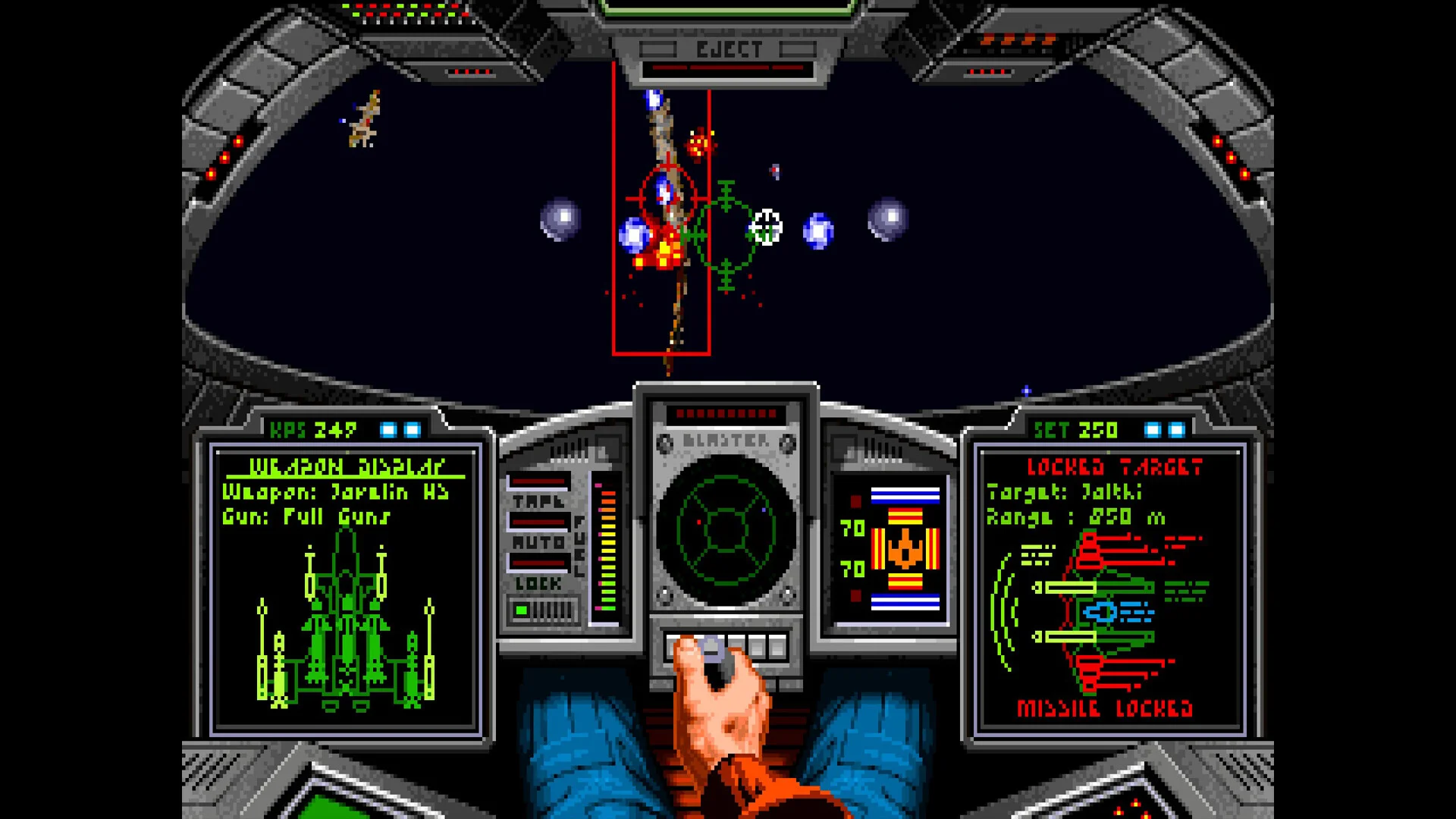
- Primary keyword: Wing Commander 35th Anniversary Edition Steam Deck controls require careful keyboard and mouse planning.
- Best starting point: Test the game with the default profile before changing individual inputs.
- Recommended layout: Use dual-stick movement, rear-button modifiers, and trackpad mouse control.
- Important limitation: Older PC interfaces may still feel more natural with a keyboard and mouse.
- Troubleshooting rule: Change one control at a time, then test it in the same scenario.
Wing Commander 35th Anniversary Edition Steam Deck controls overview
Wing Commander 35th Anniversary Edition Steam Deck controls are best approached as a Steam Input setup project rather than a simple gamepad conversion. A classic PC interface may expect keyboard commands, mouse clicks, menus, and context-sensitive actions that do not map neatly to a modern controller.
The goal is not to reproduce every keyboard key on the face buttons. Instead, build a layout around the actions you use most often:
- Flight movement on the left and right sticks.
- Common combat commands on the face buttons and triggers.
- Menu navigation on the D-pad and trackpad.
- Keyboard shortcuts on rear buttons or chorded inputs.
- Mouse-only functions through the right trackpad or touchscreen.
Use the first launch to identify how the edition handles focus, menus, cutscenes, and in-game interaction. If a command works only when the game window is active, the layout may need a dedicated mode switch or a keyboard command rather than a controller binding.
| Control area | Recommended Steam Deck input | Main purpose |
|---|---|---|
| Left stick | Analog stick | Directional movement or cursor navigation |
| Right stick | Analog stick or mouse emulation | View adjustment, cursor movement, or secondary flight input |
| Left trigger | Analog or digital action | Braking, reverse thrust, or a frequently used command |
| Right trigger | Digital action | Primary fire or confirmation |
| D-pad | Four-way buttons | Menu navigation and repeated commands |
| Trackpad | Mouse region | Pointing, selecting, and legacy interface control |
| Rear buttons | Keyboard shortcuts | Less common commands without removing thumbs from sticks |
Start with the controls that affect flight and menu access. Do not spend time mapping every available keyboard command before confirming that the core loop feels comfortable.
Flight Layer
- Movement on the sticks
- Primary actions on triggers
- Quick commands on face buttons
Interface Layer
- D-pad for menus
- Trackpad for pointer control
- Touchscreen for occasional selection
Keyboard Layer
- Rear buttons for shortcuts
- Modifier buttons for alternate commands
- On-screen keyboard for rare entries
Initial Steam Deck setup
Before creating a custom profile, confirm that the game launches correctly and that the Steam Deck can recognize its active window. Older releases can present different control behavior between the title screen, cockpit, mission briefing, and pause or save interfaces.
Follow this setup sequence:
Launch with the default profile
Start the game without immediately replacing the existing controller layout. Test whether the sticks, triggers, face buttons, and D-pad produce any useful response. This gives you a baseline for later changes.
Identify keyboard and mouse requirements
Open the game’s main menu, mission interface, and any settings screens. Record which functions require a pointer, a keyboard key, or a specific focus position.
Create a personal Steam Input profile
Duplicate the current layout instead of editing a shared profile directly. Name the copy clearly, such as “WC35 Deck Test,” so you can return to the baseline if an experiment causes problems.
Map core actions first
Assign movement, firing, confirmation, cancellation, menu navigation, and any essential in-flight command before adding secondary functions.
Test between changes
Apply one change, return to the same test area, and verify it. Small controlled changes make it easier to find conflicts caused by duplicated inputs or incorrect action layers.
The Steam Deck offers several input styles, and each one has a different strength. Analog sticks are usually easier for continuous movement, while trackpads and touchscreen input are more suitable for pointer-driven interfaces. Rear buttons are valuable when a command is important but used too infrequently to occupy a front-facing button.
| Setup stage | What to verify | Why it matters |
|---|---|---|
| Launch | Game window receives focus | Inputs may go to Steam instead of the game |
| Main menu | Selection and back commands | Confirms basic navigation |
| Briefing or interface | Pointer and click behavior | Reveals mouse-dependent screens |
| Flight | Movement and primary action | Establishes the essential control loop |
| Exit or save area | Menu focus and confirmation | Prevents confusion outside missions |
A complete replacement layout can hide the original game’s useful bindings. Keep the first profile simple and preserve a way to return to the default configuration.
External reference — November 8, 2026: Valve’s Steam Input documentation explains the broader behavior of action sets, modes, and controller bindings.
Recommended control layout patterns
There is no single universal mapping for every player, especially when a classic PC title combines flight controls with keyboard-heavy interface commands. The most reliable approach is to choose a layout pattern and adjust it after several short tests.
A practical starting arrangement looks like this:
| Deck input | Suggested role | Adjustment note |
|---|---|---|
| Left stick | Main directional control | Use a comfortable response curve for sustained movement |
| Right stick | Secondary movement or camera-style input | Switch to mouse mode if the game expects pointer movement |
| Right trigger | Primary action | Keep the most frequent action easy to reach |
| Left trigger | Brake, reverse, or secondary action | Use digital input if analog behavior feels inconsistent |
| A button | Confirm or interact | Keep it consistent across menus |
| B button | Cancel or back | Avoid assigning unrelated combat actions here |
| X button | Frequent command | Choose an action needed during active play |
| Y button | Secondary frequent command | Reserve for a command that benefits from quick access |
| D-pad | Navigation or repeated shortcuts | Avoid overloading one direction with multiple layers |
| L4/R4 | Keyboard shortcut or modifier | Useful for commands that should not interrupt movement |
| Trackpad | Mouse movement and clicking | Set a clear click action and moderate sensitivity |
For players who prefer fewer layers, place only the most common commands on the main profile. For advanced users, an action layer can temporarily transform the face buttons or D-pad while a rear button is held. This is useful when the game has more commands than the Deck has convenient physical inputs.
Simple Layout
Best for new users. Uses sticks, triggers, face buttons, and D-pad without layers.
Modifier Layout
Adds one rear-button modifier for secondary keyboard commands.
Mouse Hybrid
Keeps flight on sticks while assigning pointer movement to the right trackpad.
Keyboard Fallback
Preserves a few rear buttons for commands that do not behave well as controller inputs.
The mouse-hybrid layout is usually the most flexible first experiment for a classic PC interface because it preserves analog movement while keeping pointer access available.
Avoid binding several unrelated commands to the same button unless the action layer is obvious. A complex profile may look efficient in the editor but become difficult to remember during a mission. Consistency is more valuable than using every available input.
Troubleshooting Steam Deck input problems
Most control problems can be narrowed down by separating game behavior from Steam Input behavior. First determine whether the game receives the command at all. Then determine whether it receives the wrong command, receives duplicate commands, or loses focus.
Use the following diagnostic table:
| Symptom | Likely cause | Practical fix |
|---|---|---|
| No response from a button | Wrong input mode or inactive game window | Recheck the active layout and refocus the game |
| One press triggers two actions | Duplicate keyboard and controller bindings | Remove one of the overlapping commands |
| Cursor moves too quickly | Trackpad sensitivity is too high | Lower sensitivity and test short movements |
| Menus work but flight does not | Flight actions were never mapped | Add movement and primary actions separately |
| Flight works but menus do not | Interface requires pointer or keyboard input | Add trackpad click and navigation bindings |
| Action changes unexpectedly | An action layer is active | Review rear-button and hold bindings |
| Inputs feel delayed | Excessive smoothing or incorrect mode | Simplify the binding and reduce processing layers |
Test controls in a fixed order:
- Move the cursor or ship in a safe interface.
- Confirm one primary action.
- Open and close a menu.
- Return to active play.
- Test any modifier or rear-button command.
- Repeat the sequence after suspending and resuming the game.
If a command works in one screen but not another, do not assume the Steam Deck profile is broken. The game may use different input contexts for flight, menus, briefings, or other screens. In that case, an action set or mode shift may be more appropriate than a global remap.
Do not leave both a keyboard command and a controller command assigned to the same physical button unless the game handles simultaneous inputs correctly. Duplicate actions can cause skipped menus or repeated commands.
Control Testing Checklist:
- Confirm the game window receives input
- Test movement without pressing other buttons
- Verify primary and secondary actions separately
- Check menu confirmation and cancellation
- Test the layout after suspending and resuming
Refining comfort and reliability
Once the basic profile works, improve comfort instead of adding complexity. A good layout should let you perform common actions without looking away from the screen or remembering too many hidden combinations.
Consider these refinements:
- Adjust stick dead zones only after checking whether movement feels unstable.
- Use a lower trackpad sensitivity for menu selection and a faster setting for pointer-heavy screens.
- Keep confirmation and cancellation consistent with the rest of your Steam Deck controls.
- Assign rare commands to rear buttons rather than replacing a frequently used face button.
- Use a clear profile name that identifies whether it is experimental, keyboard-focused, or mouse-hybrid.
- Save a stable version before testing action layers or alternate modes.
| Refinement | Good target | Warning sign |
|---|---|---|
| Stick sensitivity | Smooth movement without constant correction | The ship or cursor jumps past targets |
| Trackpad sensitivity | Short swipes cover common menu distances | Small movements cross the entire screen |
| Rear buttons | Rare but important commands | Too many hidden shortcuts |
| Action layers | A small, memorable secondary set | Unclear active mode |
| D-pad | Navigation or repeated commands | Several directions perform unrelated actions |
| Profile naming | Clear version and purpose | You cannot identify the stable layout |
A keyboard and mouse may remain the better choice for long sessions if the interface depends heavily on text entry, pointer precision, or numerous simultaneous commands. Steam Deck controls can improve portability, but portability does not guarantee that every legacy interface will feel native.
After reaching a comfortable layout, duplicate it before experimenting. This gives you a known-good profile to restore when a new action layer or sensitivity change causes unexpected behavior.
FAQ about Wing Commander 35th Anniversary Edition Steam Deck controls
Q: Do Wing Commander 35th Anniversary Edition Steam Deck controls need a custom profile?
A custom profile may be useful if the default layout does not cover keyboard commands, pointer-based menus, or interface shortcuts. Start with the default profile, then add only the controls that are missing.
Q: Should I use the right stick or trackpad for mouse input?
The right trackpad is usually the more natural choice for pointer movement, while the right stick can remain available for secondary movement or another continuous action. Test both and keep the option that feels more predictable.
Q: What should I map to the rear buttons?
Use rear buttons for important commands that are not needed constantly, such as keyboard shortcuts, modifiers, or an alternate action layer. Avoid placing too many unrelated functions behind them.
Q: Why do controls work in menus but not during flight?
The game may use separate input contexts for menus and active play. Check whether the flight commands are mapped independently, then test for an active action layer or duplicate bindings.
Build a small, readable profile first. Once movement, primary actions, menu navigation, and pointer control are reliable, refine sensitivity and add secondary shortcuts gradually.