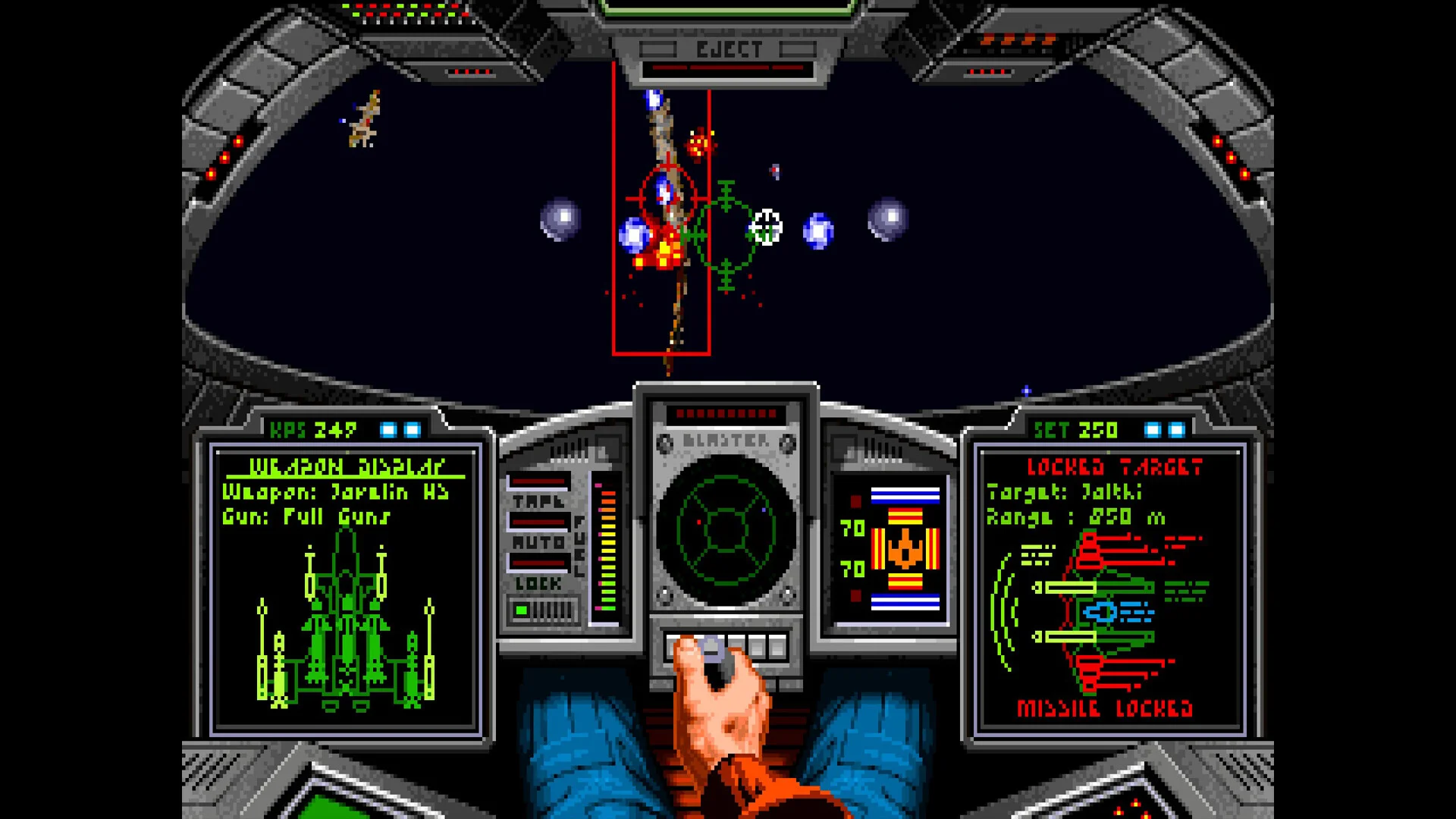
- Wing Commander 35th Anniversary Edition Steam Deck play depends on the exact store package and its compatibility layer.
- Verify the package before installation because anniversary labels may group several classic releases.
- Start with default Proton and change versions only when a specific problem appears.
- Use a mixed control layout with gamepad inputs, trackpad mouse control, and touchscreen access.
- Test one mission before changing advanced settings or building a custom profile.
Wing Commander 35th Anniversary Edition Steam Deck Overview
Wing Commander 35th Anniversary Edition Steam Deck setup is best approached as a compatibility and control-tuning task rather than a simple console-style installation. Classic PC releases often combine keyboard commands, mouse-driven menus, flight controls, video playback, and older display assumptions. A successful configuration should account for all of those layers.
The first step is identifying exactly what the anniversary package contains. Check the store page, included applications, language options, controller notes, and recent user reports. Do not assume that every title in a collection uses the same engine or control scheme. A configuration that works for one entry may be unsuitable for another.
| Verification point | What to check | Why it matters |
|---|---|---|
| Package contents | Included games and editions | Different releases may use different launchers or settings |
| Compatibility notes | Steam Deck status and Proton reports | Helps identify known startup or input issues |
| Input support | Full, partial, or keyboard-only control | Determines whether a custom layout is necessary |
| Language options | Audio, subtitles, and interface languages | Classic releases may separate language features |
| Save behavior | Local saves and cloud synchronization | Prevents confusion when switching devices |
For a first launch, keep the installation simple. Use the default graphics profile, avoid adding unofficial files immediately, and record the original settings before making changes. This gives you a reliable baseline for troubleshooting.
Package Check
Confirm the included titles, launchers, language options, and store compatibility notes before downloading.
Input Check
Test menus, cockpit controls, targeting, throttle functions, and pause commands separately.
Display Check
Compare the original aspect ratio with scaled presentation before selecting a permanent profile.
Use one game and one profile at a time during testing. Older releases can expose different problems even when they appear inside the same anniversary package.
Recommended Steam Deck Setup Path
A controlled setup sequence makes it easier to identify whether a problem comes from the game, Proton, input mapping, or display scaling. Begin in Game Mode, then use Desktop Mode only for tasks that require file management or advanced launcher configuration.
Confirm the Store Installation
Open the package page and review the listed contents, supported languages, controller information, and installation size. Install the main entry you want to test first instead of downloading every title at once.
Launch with Default Compatibility
Start the game using the default compatibility selection. Allow the first launch to finish, including any shader processing or configuration generation. Do not change several Proton versions at the same time.
Test the Complete Loop
Check the title screen, settings menu, opening sequence, save function, mission launch, and return to the main menu. A game that opens successfully may still have problems when switching from menus to flight controls.
Build a Mixed Control Layout
Assign common cockpit actions to gamepad buttons, use the trackpad for mouse prompts, and reserve touchscreen input for interfaces that do not respond correctly to analog controls.
Save the Working Profile
Once the game completes a short test session, save the controller layout with a clear name. Record the Proton version and display settings so you can restore the setup after an update.
The most useful initial layout is usually a hybrid profile. Flight movement benefits from analog input, while menus and older interface prompts may still expect a cursor. Avoid mapping every keyboard command immediately. Start with the controls required to launch, pause, target, fire, adjust power, and return to the menu.
| Control group | Suggested Steam Deck input | Setup priority |
|---|---|---|
| Flight movement | Left or right stick | High |
| Fire and targeting | Face buttons or triggers | High |
| Throttle or power | Shoulder buttons or paddles | Medium |
| Menu navigation | D-pad and face buttons | High |
| Cursor movement | Trackpad | High |
| Text or legacy prompts | Touchscreen and on-screen keyboard | Medium |
| Extra commands | Rear buttons or radial menu | Low |
Change one variable per test session. If you switch Proton, resolution, and controller mappings together, it becomes difficult to determine which change solved or created the issue.
Controls, Cockpit Input, and Mission Testing
Classic space combat games often divide their controls between flight movement and command functions. The Steam Deck can handle both, but the layout should reflect how frequently each command is used. Essential combat actions need physical buttons, while infrequent commands can remain on a radial menu or trackpad layer.
Start with a short training or low-risk mission when available. Test controls in this order: steering, throttle, weapons, targeting, communications, pause, and mission exit. This sequence reveals whether the game accepts continuous analog input, one-shot button presses, or keyboard-style commands.
| Mission function | Preferred mapping style | Reason |
|---|---|---|
| Pitch and yaw | Analog stick | Allows gradual movement |
| Roll | Shoulder button pair or stick modifier | Keeps directional control available |
| Primary weapon | Trigger | Easy to access during movement |
| Secondary weapon | Opposite trigger or face button | Separates weapon functions |
| Target cycling | Shoulder button | Frequent combat command |
| Communication menu | Face button | Quick access without cursor movement |
| Pause or mission menu | Menu button | Consistent system-level access |
If the game recognizes only partial controller input, do not interpret that as a complete failure. Some releases may support gameplay inputs while still requiring mouse movement in menus. A hybrid layout is often more practical than trying to replace every keyboard command.
Use the touchscreen as a backup rather than the primary control method. Touch input is helpful for selecting small menu items, dismissing prompts, or interacting with older launchers. During combat, physical controls are generally easier to use consistently.
Do not rely on an untested custom layout for a long campaign session. Verify targeting, weapon selection, pause behavior, and save access before committing progress.
Control Test Checklist:
- Confirm the main menu accepts button input
- Verify flight movement and roll controls
- Test primary and secondary weapon commands
- Check target cycling and communication prompts
- Open the pause menu and save after testing
Display, Performance, and Compatibility Troubleshooting
The goal of display tuning is consistency, not maximum visual alteration. Older games may use fixed resolutions, pre-rendered scenes, or video sequences that respond differently to scaling. Begin with the original presentation, then adjust one setting at a time.
A stable frame rate is useful, but it is not the only performance factor. Stuttering during video playback, delayed menu input, incorrect aspect ratios, and inconsistent audio can be more distracting than modest visual softness. Test a complete transition from menus to gameplay before deciding that the configuration is ready.
| Symptom | First response | Avoid doing first |
|---|---|---|
| Game does not start | Restart, verify files, test default Proton | Changing several compatibility tools |
| Menus ignore buttons | Add trackpad or touchscreen cursor control | Rebinding every keyboard command |
| Wrong aspect ratio | Test game resolution and scaling options | Stretching the image immediately |
| Video playback problem | Try another Proton version or launch option | Deleting configuration files |
| Audio delay | Check in-game audio settings and system output | Installing unrelated fixes |
| Save not detected | Confirm the active prefix and installation path | Moving save files without a backup |
If a change improves one feature but damages another, return to the last known working configuration. Keep a short note containing the game title, Proton version, resolution, refresh setting, and controller layout name. This information is especially valuable when testing multiple entries from the same collection.
Desktop Mode is best reserved for advanced tasks such as inspecting folders, creating backups, or managing a launcher that does not behave correctly in Game Mode. Make a backup before editing configuration files. Avoid downloading unofficial patches unless you understand what they change and whether they match your specific release.
A launcher, menu, or cinematic issue may be separate from mission performance. Test each stage independently so you can apply a narrow fix instead of replacing the entire setup.
A practical troubleshooting order is:
- Restart the game and Steam Deck.
- Verify installed files.
- Return to the default Proton selection.
- Test a different display mode.
- Add cursor support through the trackpad or touchscreen.
- Try another Proton version only after recording the current configuration.
- Restore the previous profile if the new change creates additional problems.
| Configuration area | Safe starting choice | When to adjust |
|---|---|---|
| Proton | Default selection | Startup or video compatibility issue |
| Resolution | Original or native-compatible option | Image distortion or unreadable interface |
| Scaling | Preserve aspect ratio | Borders or excessive softness |
| Frame limit | Default system behavior | Heat, battery, or uneven pacing |
| Controller layout | Basic hybrid profile | Missing menu or cockpit commands |
Best Practices for Long Sessions
Once the game launches, controls respond, and saves work, build a repeatable routine. Classic games can be enjoyable on the Steam Deck because short sessions are easy to resume, but inconsistent profiles can make later troubleshooting harder.
Use a descriptive controller layout name such as “Cockpit Hybrid - Tested.” If you create separate profiles for different entries, include the title or game number in the name. Keep the most important commands on physical inputs and place rarely used functions on a modifier layer.
Before beginning a long campaign session, confirm these points:
- The correct title and edition are installed.
- The selected controller layout matches that title.
- A recent save loads correctly.
- The display is comfortable in handheld mode.
- Mission controls work without reaching for the touchscreen.
- The device has enough battery for the intended session.
Handheld Profile
Prioritize readable text, comfortable brightness, physical controls, and a preserved aspect ratio.
Docked Profile
Check external resolution, cursor visibility, and whether the interface remains legible at a distance.
Keyboard Profile
Retain the original command structure and use the trackpad for mouse movement.
Recovery Profile
Keep a basic layout available for troubleshooting or first launches after an update.
The best profile is the one that reduces friction without hiding important commands. Avoid adding complex layers until the basic controls are reliable. When a mission requires a rarely used function, a radial menu is usually easier to remember than a crowded button layout.
After every major configuration change, load a recent save and complete a short control test. This protects progress and confirms that the profile still behaves correctly.
FAQ: Steam Deck Setup Questions
Q: Is Wing Commander 35th Anniversary Edition Steam Deck setup plug-and-play?
It may require some tuning. The exact experience depends on the included release, controller support, launcher behavior, and Proton compatibility. Start with default settings and test the complete menu-to-mission loop.
Q: Should I use a custom controller layout immediately?
No. Test the default layout first, then add only the missing functions. A hybrid profile using gamepad controls, trackpad cursor input, and touchscreen backup is a practical starting point for older PC interfaces.
Q: Which Proton version should I choose?
Begin with the default compatibility selection. Change versions only when you have a specific startup, video, audio, or input problem, and record each change so you can return to the last working configuration.
Q: How can I avoid losing progress during testing?
Create a manual save before changing settings, verify that the save loads, and keep a written note of your profile and compatibility settings. Back up files before modifying folders in Desktop Mode.
Treat the anniversary package as a group of individual classic PC releases. Test each title separately, keep controls simple, and preserve every working configuration.