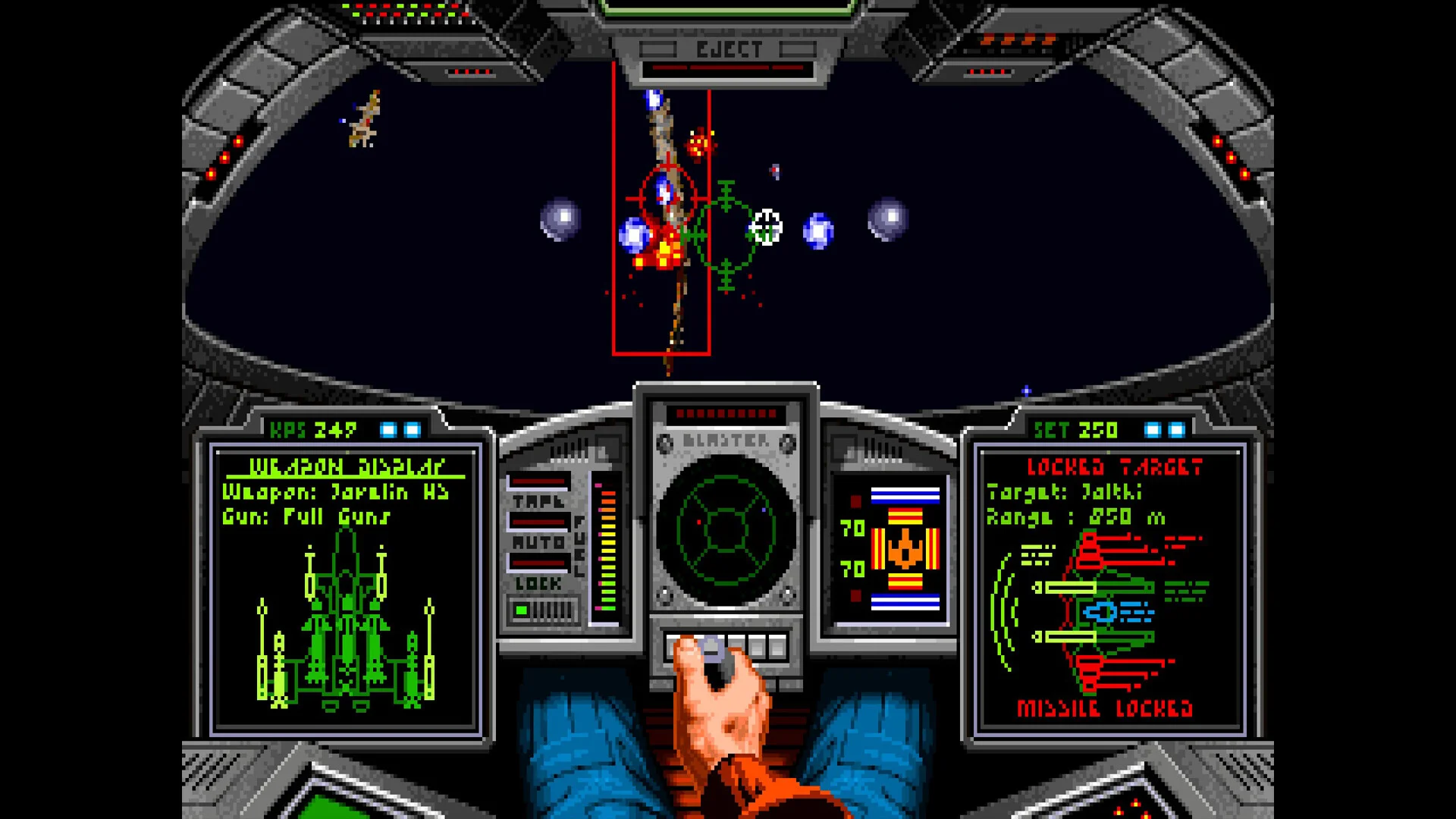
- Wing Commander 35th Anniversary Edition gameplay guide basics begin with controls, display settings, and save habits.
- Throttle control matters more than constant weapon fire during turning engagements.
- Mission discipline helps you protect objectives instead of chasing every target.
- Campaign order is ideal for first-time players, while veterans can sample individual entries.
- Manual saves provide a safety net before difficult sorties and branching decisions.
Wing Commander 35th Anniversary Edition Setup Basics
The first stage of a successful campaign is making the classic space-combat format comfortable on modern hardware. The collection brings together games from different eras, so control layouts, display behavior, audio balance, and menu conventions may vary between entries. Treat each title as its own cockpit rather than assuming one configuration will work perfectly everywhere.
Start by opening the control settings before launching a serious mission. Identify throttle controls, targeting commands, weapon selection, afterburner or speed controls, communications, and the command for returning to a previous menu. If a title offers controller support, test every essential command in a safe training segment or early mission.
| Setup Area | Recommended Action | Why It Matters |
|---|---|---|
| Controls | Confirm steering, throttle, targeting, weapons, and communications | Prevents avoidable mistakes during the first sortie |
| Display | Choose a readable resolution and check aspect ratio | Preserves cockpit visibility and interface clarity |
| Audio | Balance music, dialogue, effects, and radio volume | Important briefings and combat warnings remain audible |
| Saves | Create a manual save before major missions | Protects progress when a mission outcome is poor |
| Input Device | Use the control method that gives steady aim | Consistency is more valuable than a specific device |
Classic Controls
Best for players who want the original feel. Spend time learning directional input, throttle changes, and weapon timing before increasing difficulty.
Modern Comfort
Adjust sensitivity, bindings, and display options where available. The goal is reliable control rather than strict historical accuracy.
Campaign Explorer
Keep separate saves for different campaigns or decision points. This makes it easier to revisit story branches without losing progress.
Do not change several control options at once. Adjust one setting, test it in flight, and keep the configuration that produces predictable movement.
Step-by-Step First Sortie Routine
The opening missions are the best place to build repeatable habits. Avoid treating every encounter as a race to destroy the first visible target. A controlled approach improves survival, preserves ammunition, and gives you more time to understand how each game handles speed, targeting, and mission objectives.
Read the Briefing
Note the primary objective, escort responsibilities, patrol area, and any conditions that can cause failure. If the mission includes several tasks, identify which one must be protected first.
Check the Loadout
Review available weapons, ammunition, defensive equipment, and ship limitations. Choose a balanced configuration until you understand the mission type.
Set a Manageable Speed
Use a moderate throttle while approaching the combat zone. Excessive speed can separate you from allies, while low speed can make you an easy target.
Acquire One Target
Select a priority target and stay aware of nearby threats. Avoid switching targets repeatedly unless the mission objective changes.
Reassess After Combat
Confirm the objective status, check remaining ammunition, and decide whether to continue, regroup, or follow the extraction instruction.
| Mission Phase | Main Focus | Common Error |
|---|---|---|
| Briefing | Understand objectives and failure conditions | Remembering only the first sentence |
| Approach | Maintain formation and awareness | Flying directly toward every contact |
| Engagement | Prioritize threats and manage speed | Holding the trigger without a plan |
| Objective | Protect the assigned target or area | Chasing a fleeing enemy too far |
| Withdrawal | Follow extraction or regroup orders | Continuing combat after the mission is effectively complete |
A destroyed enemy is not always more important than a surviving ally, transport, or objective. If the mission gives you an escort or defense task, protect it before pursuing optional targets.
Combat Tips for Space Engagements
Wing Commander combat rewards positioning and timing more than constant aggression. Many new pilots turn too sharply, overshoot targets, and then spend the rest of the encounter trying to regain a firing angle. Use controlled turns, manage your speed, and create opportunities to fire when the target is within a stable line of attack.
The most useful combat rhythm is simple: acquire, position, fire, disengage, and reassess. This rhythm keeps you from wasting ammunition and helps you recognize when a target is baiting you into a dangerous area.
Positioning
Stay aware of your target’s direction and avoid flying straight through its path unless the maneuver is intentional.
Throttle
Adjust speed during turns. Matching the encounter tempo is often more useful than staying at maximum speed.
Target Priority
Remove immediate threats to mission objectives before chasing damaged or retreating enemies.
Disengagement
Break away when shields, armor, ammunition, or situational awareness become dangerously low.
| Combat Situation | Preferred Response | Avoid |
|---|---|---|
| One enemy is isolated | Close carefully and use controlled bursts | Emptying ammunition before confirming hits |
| Several enemies converge | Keep an escape route and watch the radar | Fixating on one target |
| An escort is threatened | Intercept the attacker and stay near the objective | Chasing a distant retreating ship |
| You lose the target | Recheck sensors and mission markers | Randomly turning until disoriented |
| Your ship is damaged | Reduce exposure and follow mission priorities | Continuing every optional engagement |
A good firing opportunity usually appears after a target commits to a turn or becomes predictable near an objective. Fire in short, deliberate bursts when the target is aligned. If your attack does not connect, reposition instead of holding the trigger and hoping the next shot lands.
Defensive flying is also an offensive tool. Breaking away can force an opponent to overshoot, expose its rear arc, or separate from its formation. Use that moment to regain a favorable angle rather than treating retreat as failure.
The strongest attack is usually the one you can repeat safely. Preserve control, ammunition, and awareness so you can create another firing opportunity.
Campaign Order and Progression Planning
The collection is best approached with a clear plan. New players should generally begin with the earliest campaign available to them and move forward, because this preserves the development of the setting, mechanics, and recurring story elements. Players returning for nostalgia may instead start with a favorite entry before exploring the rest of the collection.
Do not rush through every title in a single sitting. The games differ in pacing, mission structure, presentation, and control feel. Short sessions make it easier to recognize which systems belong to the current game rather than carrying assumptions from another entry.
| Playstyle | Suggested Approach | Advantage |
|---|---|---|
| First-time player | Begin with the earliest mainline campaign | Builds familiarity in a natural order |
| Returning veteran | Start with a favorite entry, then explore adjacent titles | Provides a quick nostalgia-driven entry point |
| Story-focused player | Follow campaign order and read briefings carefully | Preserves narrative context |
| Systems-focused player | Compare controls and mission design between entries | Highlights how the series evolved |
| Limited-time player | Sample early missions from several titles | Helps identify the best personal fit |
Before Starting a New Campaign:
- Confirm the control layout for the selected title
- Create a manual save before the first major mission
- Read each briefing and identify the primary objective
- Record any important campaign decision or branch
- Keep separate saves for different story paths
Keep a simple campaign log if you want to understand branching outcomes. Record the mission name, result, major choice, and next assignment. This is more dependable than relying on memory, especially when returning to a campaign after several days.
A slower first playthrough is often more rewarding. The collection’s value comes from seeing how its campaigns, missions, characters, and presentation work together.
Save Management, Difficulty, and Recovery
Classic campaign games can punish careless progress management. A failed sortie may teach you something valuable, but replaying a long sequence after an avoidable mistake can make the experience frustrating. Use a small set of clearly named saves rather than overwriting the same file every time.
A practical save structure includes one campaign save, one pre-mission save, and one decision-point save. If the game uses a different system, apply the same principle with the tools available in that title.
| Save Type | When to Create It | Purpose |
|---|---|---|
| Campaign Master | At the beginning of a play session | Gives you a stable recovery point |
| Pre-Mission | Before launching an important sortie | Allows a clean retry without losing progress |
| Decision Point | Before a major story choice | Makes alternate outcomes easier to explore |
| Post-Mission | After a successful result | Protects completed progress |
| Experiment Save | Before testing unfamiliar controls or tactics | Keeps experimentation separate |
When a mission fails, identify the cause before retrying. Was the target lost because of poor positioning, insufficient speed control, weak target priority, or a missed briefing instruction? A focused adjustment is more effective than repeating the same approach with more aggression.
If the difficulty setting feels overwhelming, use it as a learning tool rather than a permanent judgment of skill. Lower difficulty can help you understand mission flow, while a later replay can provide a stronger challenge once the controls and objectives are familiar.
Do not overwrite your only successful campaign save before testing a difficult mission path. Keep at least one earlier recovery point whenever the game allows it.
Long-Term Goals and FAQ
The best long-term goal is not simply finishing every campaign as quickly as possible. Aim to understand each title’s mission structure, improve your flying discipline, and revisit important story decisions with a reliable save plan.
Use the following milestones to organize a full collection playthrough:
- Finish the opening missions without changing controls repeatedly.
- Complete a campaign while protecting optional objectives where practical.
- Revisit a difficult mission after identifying the actual failure cause.
- Compare how different entries handle speed, weapons, briefings, and mission flow.
- Maintain organized saves for future story-path exploration.
| Milestone | Completion Standard | Benefit |
|---|---|---|
| Setup | Controls and display are comfortable | Reduces technical friction |
| Fundamentals | You can manage speed and targeting | Improves combat consistency |
| Mission Discipline | Primary objectives remain your focus | Prevents avoidable failures |
| Campaign Knowledge | You understand major decisions | Makes replay planning easier |
| Collection Mastery | You can adapt between titles | Builds confidence across the series |
Q: What should I do first in the Wing Commander 35th Anniversary Edition gameplay guide?
Begin with control setup, display checks, and save management. Then play an early mission slowly so you can learn throttle behavior, targeting, weapon selection, and objective priorities.
Q: Should I play the collection in release order?
Release or campaign order is a strong choice for first-time players because it preserves the progression of the setting and mechanics. Returning players can begin with a favorite title and explore outward.
Q: How can I avoid wasting ammunition during combat?
Use deliberate bursts when your target is aligned, avoid firing during unstable turns, and reassess the encounter before committing to another attack.
Q: What is the best way to handle a failed mission?
Review the briefing, identify the specific failure cause, reload a suitable save, and change one tactical behavior at a time. Protecting the primary objective should usually come before chasing optional targets.
Play patiently, keep organized saves, and treat every mission briefing as part of the gameplay. Consistent decisions will carry you farther than constant aggression.